
AI WhatsApp Chatbot for Shopify India
What a good AI WhatsApp chatbot for Shopify looks like in India: live SKUs, ₹ prices, COD FAQs, Meta-safe behavior, and clean handoff to humans.

An AI WhatsApp chatbot for Shopify India should answer from live catalog data (SKUs, sizes, ₹ prices) then hand off to humans when intent is purchase risk, COD doubt, or complaint.
Hallucinated inventory destroys trust faster than slow replies.
Must-have behaviors
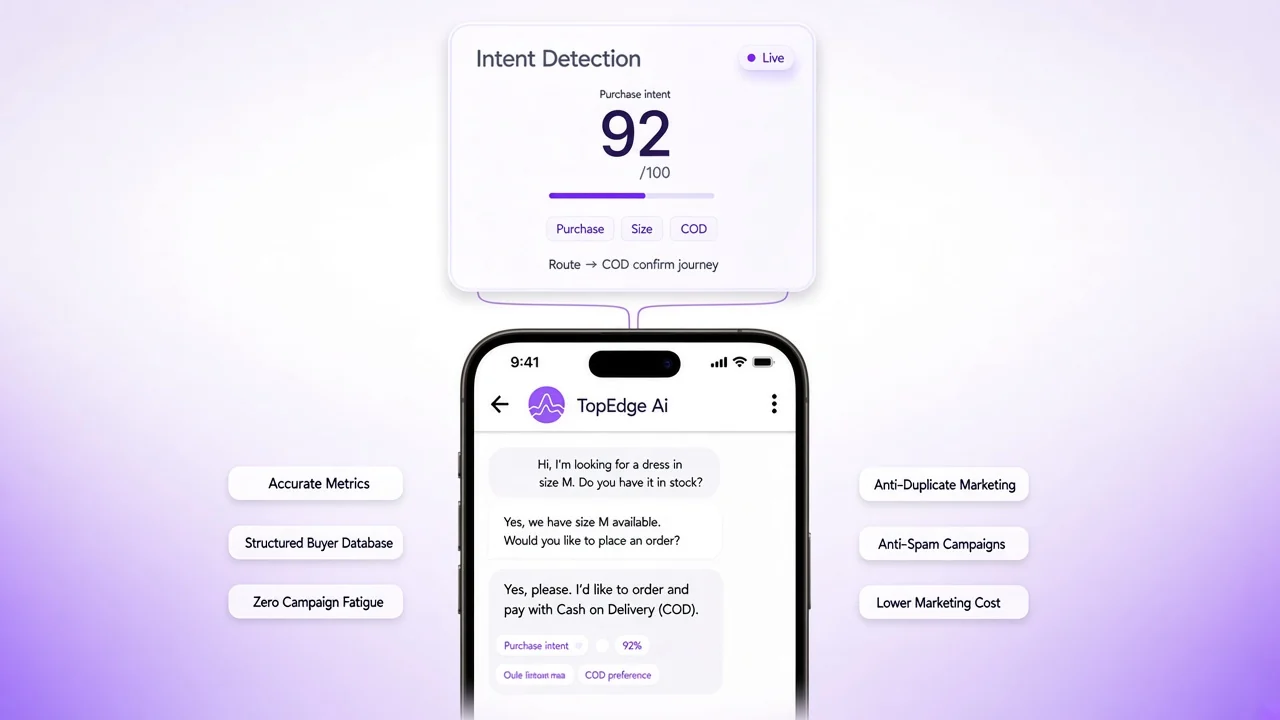
- Ground answers in Shopify catalog and order APIs
- Pause AI when an agent joins the thread
- Route COD, refund, and damage topics carefully
- Respect Meta policies, opt-outs, and quiet hours
- Never invent a discount or shipping promise ops cannot keep
Configure grounding and escalation in AI Brain, with humans in Live Chat.
The first item on that list is the one that makes the rest possible.
An assistant reading your live Shopify catalogue and order data can say whether the medium is in stock and where order 4192 is tonight.
The same assistant without that connection will answer both questions anyway, fluently and wrongly, and you will either honour the invention or argue with a customer holding a screenshot.
When a vendor demos AI, ask to see the data source, not the chat window.
Quiet hours deserve a real decision rather than a default. Indian D2C buyers message at 11pm, and an assistant that answers a size question at midnight is genuinely useful.
One that sends an unprompted marketing nudge at midnight generates the blocks that drag your Meta quality rating down, which throttles the order confirmations you depend on.
Compare how AI is billed, because the structures are not close. Interakt sells AI Agents as a ₹3,000 a month add-on with 100 free messages then ₹0.50 each.
Updatrr puts its AI chatbot with human handover on its $99.99 tier, roughly ₹9,400 a month at about ₹94 to the dollar.
Bring-your-own-key, where you pay OpenAI or Gemini directly, runs nearer ₹0.10 to ₹0.30 a reply. At 500 replies that is about ₹3,200, ₹9,400 and ₹100.
Where AI helps vs where it hurts
- Helps: size charts, product diffs, order status lookups, store policy FAQs
- Hurts: arguing RTO blame, custom pricing, medical claims, “guaranteed delivery tomorrow” without courier truth
Tip: Start AI on after-hours FAQs only. Expand intents after you review transcripts for a week. The setup steps are in train the AI to answer customer questions.
The dividing line is simple once you say it out loud: if a wrong answer creates a liability, a human owns the thread.
Sizes, materials, care instructions and published policies are safe, because the answers are stable, already written down somewhere, and a mistake is recoverable with an apology.
Prices, live stock, delivery dates and refund eligibility are not, because a wrong answer becomes a commitment the customer can screenshot.
The “guaranteed delivery tomorrow” example is worth dwelling on, because it is the one that recurs.
No assistant can promise a delivery date unless it is reading courier data, and almost none are.
What it can safely say is what your policy says: dispatch within 24 hours, typical delivery in three to five days for that pincode band.
The difference between a promise and a stated norm is the difference between a complaint and an expectation.
Read the first week of transcripts yourself. Not a sample, all of them.
It is a few hours of work that tells you which intents to open next and, more usefully, which three questions your product pages should have answered so the conversation never has to happen.
COD and RTO-aware design
Indian buyers ask “COD available?” and “can I cancel before delivery?” constantly, and both questions are really the same one: how much am I committing to right now.
An assistant that reads payment method and order state from Shopify can answer precisely. One that cannot should hand off rather than guess, because both answers have money attached.
“COD available for my pincode?” is usually the most frequent inbound message on an Indian Shopify store, and it is a pre-purchase question, which makes it the highest-value thing an assistant can get right.
Answering it accurately converts; answering it wrongly either loses the sale or creates an order you cannot fulfil on the terms promised.
If it is in your top three contact reasons, the real fix is a pincode checker on the product page, with the assistant as backup.
“Can I cancel before delivery?” is an RTO signal arriving early, and it should be treated as one.
The customer is telling you they have second thoughts while the parcel is still cheap to stop. Route it to a human or to a cancellation flow immediately.
Letting an assistant reassure them and close the conversation produces a doorstep refusal a week later, which costs both freight legs.
Deflection and confirmation do different jobs and neither substitutes for the other. Pair chatbot deflection with confirmation journeys in Journeys.
Chatbots do not replace COD confirmation.
Build flows around AI, not instead of it
Use Flow Builder for deterministic paths such as exchange policy steps and address update forms. Use AI for open-ended catalogue questions.
Deterministic beats clever when money moves.
The division is about variance, not capability.
A flow does the same thing every time, which is exactly what you want for a return request, an address correction or a COD confirmation, because those have a correct sequence and a record that has to end up on the order.
An assistant is better at the long tail of phrasings nobody can enumerate, which is most product questions.
The useful pattern is AI at the front, flow at the point of action.
Let the assistant understand “the shirt is too tight, can I swap it”, then hand into a deterministic exchange flow that collects the order number, the size wanted and the pickup address in a fixed order.
You get natural language where it helps and auditable structure where it matters.
Write down which intents are allowed to end in an action. An assistant that can answer anything but can only trigger three flows is a safe system.
One that can improvise its way into issuing a refund is not, and the cost of finding out is a reconciliation problem rather than a bad review.
When should an AI chatbot hand off to a human?
Hand off when any of these are true:
- The customer asks for a person
- Confidence is low, or retrieval found nothing solid
- Tone is angry, threatening or distressed
- Payment failed, chargeback risk, or an address dispute
- Custom quotes, wholesale or B2B exceptions
- Medical, legal or regulated claims
- High-value orders, where a wrong answer is expensive
Handover is not a failure metric if it is fast and carries context. It is a failure when the bot loops, invents facts, or keeps talking after an agent joins.
Takeover in Live Chat pauses AI and Flow Builder on that thread until it is released.
Guardrails that stop invented answers
A model with no stated return window will invent one. The limits are what stop invention, so write down what you do not offer as carefully as what you do.
- If the model cannot see live price or stock, it should say so and hand off, not guess. Hallucinated "in stock" costs more than "let me get a specialist".
- No invented discount codes, and no shipping promise operations cannot keep.
- Write actions like cancel and refund stay behind rules until read-only answers have earned trust.
- Measure wrong-answer rate, not only deflection rate. Deflection alone rewards a bot that answers everything badly.
- Re-test after a returns-window or policy change. Training on last quarter's policy is the most common cause of a confidently wrong reply.
What to look for in a tool
- Shopify grounding: catalog, policies and orders, not only a website scrape
- Handover that pauses the bot, not a handover that leaves it talking
- Intent routing, so shipping, returns and COD questions get answered without spending tokens on every message
- Transcript review tools, because you will tune this weekly
- A cost model you can predict: included AI, bring-your-own-key, or a per-message add-on
- Journeys alongside it. Chatbots answer; journeys still recover carts and confirm COD.
What an AI reply costs in India after October 2026
Since 1 October 2026 an AI reply has two cost layers, not one, and most vendor pricing pages only show you the second.
Layer one is Meta's. Every reply your bot sends inside the 24-hour window is a service message: the first 1,000 per phone number per month are free, then Meta charges ₹0.1150 each in India.
That applies no matter which AI you use, and it did not exist before October.
Layer two is the model, and this is where the published rates diverge sharply.
| How you run the AI | Model cost per reply | Plus Meta service fee past 1,000/mo | 5,000 replies a month |
|---|---|---|---|
| Bring your own key (OpenAI or Gemini direct) | About ₹0.10 to ₹0.30 | ₹0.1150 | ₹960 to ₹1,960 |
| Interakt AI Agents | ₹0.50 after 100 free, plus a ₹3,000 add-on | ₹0.1150 | ₹5,910 |
| Meta Business Agent (token billed since 1 Aug 2026) | ₹3.40 to ₹4.25 ($2.00 per 1M tokens at 20k to 25k tokens a reply) | Bundled into the token rate | ₹17,000 to ₹21,250 |
| Per-resolution bots (Zoko Guru and similar) | Billed per resolved conversation rather than per reply, about $0.09 a resolution on Zoko's published listing | ₹0.1150 per reply | Depends on replies per resolution |
| AI behind a plan tier (Updatrr and similar) | No per-message fee published; AI sits on the top tier, $99.99 a month on Updatrr | ₹0.1150 per reply | About ₹8,500 in tier cost |
That is a 10x to 20x spread on the same job, which is why the cost model deserves as much scrutiny as the answer quality.
Note also that the bottom two rows are not priced per message at all: a per-resolution bot gets cheaper the more replies it takes to resolve a ticket, which is the opposite incentive to yours, and a tier-gated AI costs the same whether you send 50 replies or 5,000.
Compare the shape before the rate. Two things make the gap real rather than theoretical:
- Intent routing cuts the model bill to zero on the easy half. "Where is my order" and "what is your return policy" do not need a language model at all: they need a lookup. Routing those deterministically means you only pay model tokens on questions that genuinely need reasoning, and the Meta ₹0.1150 is the same either way.
- Token cost is falling, per-message pricing is not. A bring-your-own-key setup inherits every price cut the model providers make. A ₹0.50 per message contract does not.
The honest cost of bring-your-own-key: you hold the OpenAI or Gemini account, you watch that bill, and a badly configured bot that sends 4,000-token prompts will cost more than the range above.
It is cheaper at volume and it is one more thing to own. Full rate card in the India WhatsApp API pricing guide, and the Interakt comparison in the Interakt alternative post.
Quality loop for operators
- Sample 50 AI transcripts weekly
- Tag failures: wrong price, wrong stock, tone, missed handoff
- Fix grounding sources or add macros
- Re-test after catalog or policy changes
See AI beside the rest of the stack on AI Brain, connect store data via Shopify WhatsApp integration, and compare platforms on compare.
For tool selection criteria, read best WhatsApp automation tools. Questions?
Related: the shared inbox with Shopify order context and what ecommerce automation on WhatsApp actually covers.
Sources and further reading, read 21 October 2026. The 1,000 free service messages a month per phone number (effective 1 October 2026), the India ₹0.1150 service rate and Meta Business Agent token billing at $2.00 per million tokens (effective 1 August 2026): Meta’s WhatsApp Business Platform pricing documentation. Interakt’s ₹3,000 AI add-on, 100 free AI messages and ₹0.50 per AI message: Interakt’s pricing page. Zoko’s per-resolution AI pricing was read off its Shopify App Store listing and Updatrr’s $99.99 Pro AI tier off its pricing page; both vendors move their tiers, so confirm before you compare. The ₹0.10 to ₹0.30 bring-your-own-key range is our own estimate of model token cost per reply, not a published price. Template categories, review and the reasons templates get rejected: Meta’s message template guidelines. Opt-in requirements: the WhatsApp Business Messaging Policy.
Common questions
What should an AI WhatsApp chatbot handle for a Shopify store?
Order status, delivery timelines, return and exchange policy, sizing and product questions, address changes and basic troubleshooting. These are repetitive, fact-based and verifiable, which is exactly where AI is reliable. They also make up the majority of inbound volume for most stores.
What should an AI chatbot never handle alone?
Anything involving money, a complaint, or a legal question. A confidently wrong answer about a refund or a delivery promise costs far more than the time it saved, and customers escalate those publicly. Route refunds, damage claims and disputes to a human by design, not as a fallback.
Why does my chatbot give wrong answers?
Almost always because the knowledge behind it is incomplete. A model with no stated return window will invent one. Fill in shipping times, return conditions, payment methods and, critically, what you do not offer, because the limits are what stop invention.
Does an AI chatbot need to be COD-aware in India?
Yes. COD changes the conversation: customers ask whether cash on delivery is available for their pin code, how much to keep ready, and whether they can switch to prepaid. A bot that cannot answer those is missing the most common question category in Indian ecommerce.
What is the best chatbot for a Shopify store in India that works on both WhatsApp and the website?
The one grounded in your Shopify catalog, policies and orders, so it gives the same correct answer on every channel. Check that it handles COD questions and hands off to a human cleanly, and confirm on a live demo which channels each vendor’s bot actually runs on.
Run cart recovery on your
Shopify store
Connect Shopify and WhatsApp Cloud API, approve your Meta templates, and publish the first journey. Free for 14 days, no card.
4.2 out of 5 on Trustpilot, from 6 reviews
The overall software experience is top-notch, it's Indian software but feels like US Grade software quality.
Share this article


