
Products + COGS
Enter COGS and packaging, uniform or per product, so margin starts from real unit costs.
Multiple Apps Complete D2C Suite Signup 14-days trial to access everything.
Net profit after COGS, COD fees, RTO, gateway charges and ad spend, the lines Shopify admin leaves out.
Trusted by





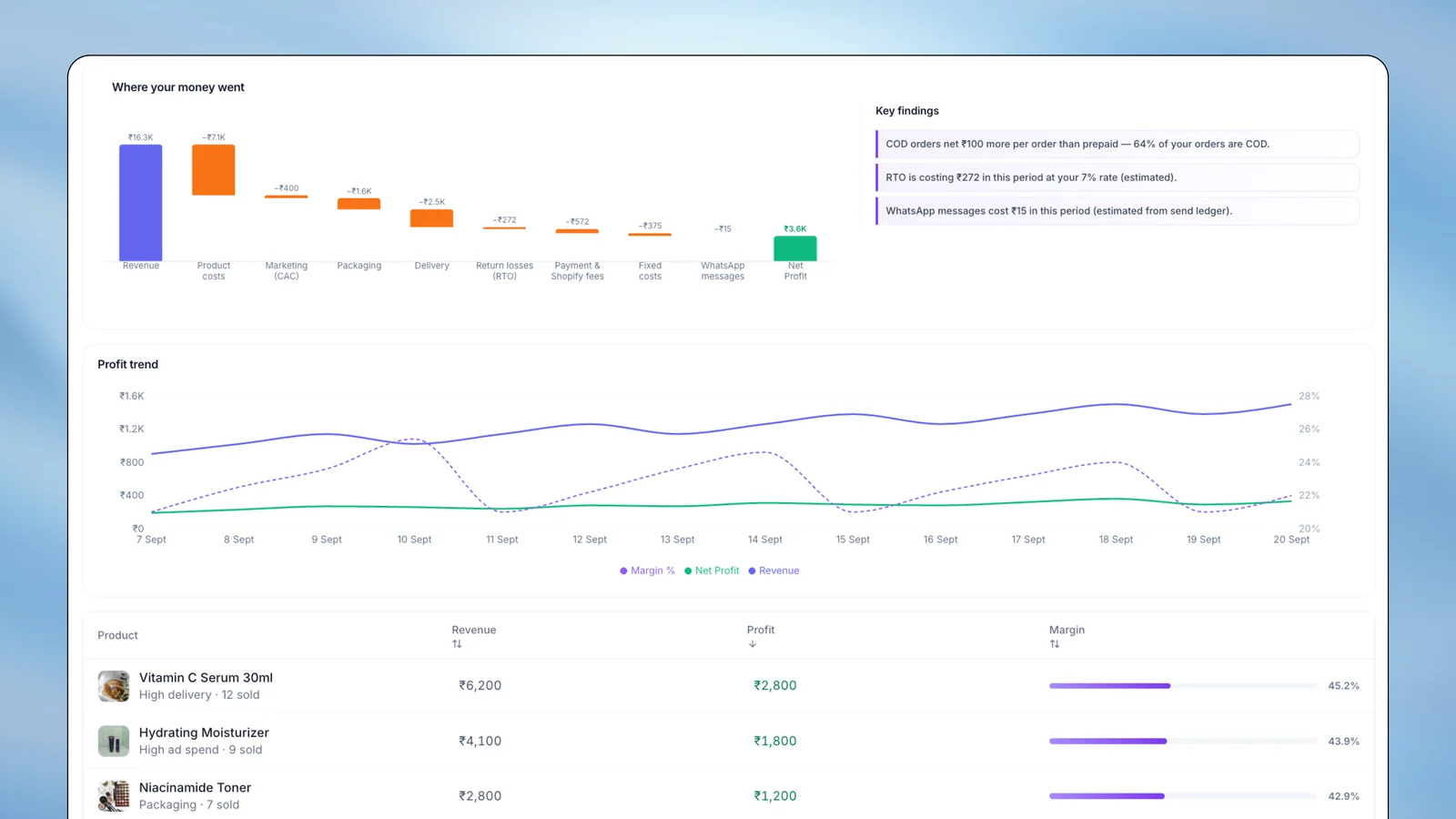
Three-step wizard, then a live dashboard that answers what you kept after Indian D2C costs.
Enter COGS and packaging, uniform or per product, so margin starts from real unit costs.
Ad spend, gateway %, Shopify fees and optional fixed overhead per order.
COD share, delivery cost, RTO rates and the loss on each refused COD order.
True net profit in ₹ against the prior period, with revenue, orders, margin and AOV.
Revenue to net profit step by step, with the biggest cost and the COD and RTO drivers called out.
Revenue, cost, profit and margin per SKU. Products missing COGS sink to the bottom.
Five cost lines separate the freight number you see from the one you pay. Amazon Shipping India works it through on a ₹799 women’s cotton kurta weighing 300g, and this is the waterfall Profit & costs builds from your own Shopify data.
| Cost line | Amount | How it is arrived at |
|---|---|---|
| Packaging materials | ₹13 | ₹10 poly mailer, ₹2 tape, ₹1 label |
| National freight | ₹85 | Volumetric weight (32 x 25 x 5) / 5,000 = 0.80 kg, billed at the 1 kg slab on a 300g product |
| COD remittance fee | ₹30 | Standard charge on a cash on delivery order |
| Visible cost | ₹128 | The three lines above, the ones that appear on an invoice |
| Amortised RTO cost | ₹38 | 30% RTO rate x ₹125 incremental reverse cost per return |
| Customer support time | ₹13 | 40% touch rate x ₹32 per interaction (20 minutes at ₹96/hr) |
| True total | ₹179 | More than double the ₹85 the seller thinks they are paying |
Every line read off Amazon Shipping India’s true cost per order breakdown (shipping.amazon.in/blog/true-cost-of-shipping-per-order-india, published 15 July 2026, read 21 October 2026). The 30% RTO assumption sits inside the fashion and apparel band of 25% to 40% published by ClickPost. These are national indicative figures, not your rate card: your courier contract, category and parcel dimensions move every line, which is the reason to compute it from your own data rather than ours.
Products + COGS, fees, then COD & returns, three steps, then recalculate anytime.
Sample mode is labeled until the store is live, no fake “live P&L” claim.
Today, 7d, 30d, 90d, or all synced, compare vs prior period in ₹.
Cut SKUs or channels that destroy margin after RTO and ads, edit setup when costs change.
Product COGS, packaging, payment fees, COD and RTO losses, and marketing. Together they give net profit for an Indian D2C store.
No. It is unit-economics reporting that sits beside your WhatsApp tools, so you do not grow send volume while losing money on COD returns.
Cost of goods, packaging, payment gateway fees, shipping, COD RTO losses and ad spend. That is the gap between revenue and what finance actually banks, which is why ROAS can look healthy while margin is gone.
Yes. The product table shows margin percentage per SKU, which is usually where a single loss-making variant is hiding behind a profitable average.
Subtract India-specific costs from net sales: COGS, packaging at about ₹12 to ₹24 a box, freight on volumetric weight, a COD fee of about ₹30 a parcel, amortised RTO loss, gateway fees and acquisition cost. On Amazon Shipping India’s worked ₹799 kurta example, those lines turn ₹85 of visible freight into ₹179 of true cost. Profit & costs builds that waterfall from your own Shopify data.
₹180 to ₹240 in direct logistics per returned parcel, per Amazon Shipping India: forward and reverse shipping, repackaging and inventory holding. ClickPost puts the fully loaded loss at ₹450 to ₹900 once written-off acquisition spend is counted.
Because it reports the order, not the outcome. A COD order refused at the door still counts as revenue until it is cancelled, while its freight and ad spend are already gone. Unicommerce recorded festive-quarter COD return rates near 58% against under 15% for prepaid.
India-aware P&L, COGS, COD, RTO, ads, honest net ₹, not vanity revenue.