AI Chatbot for Shopify: Support and Sales Guide
What an AI chatbot for Shopify actually does: catalog answers, order lookups, sales assist, human handover rules, and how to avoid invented prices or stock.
Direct answer
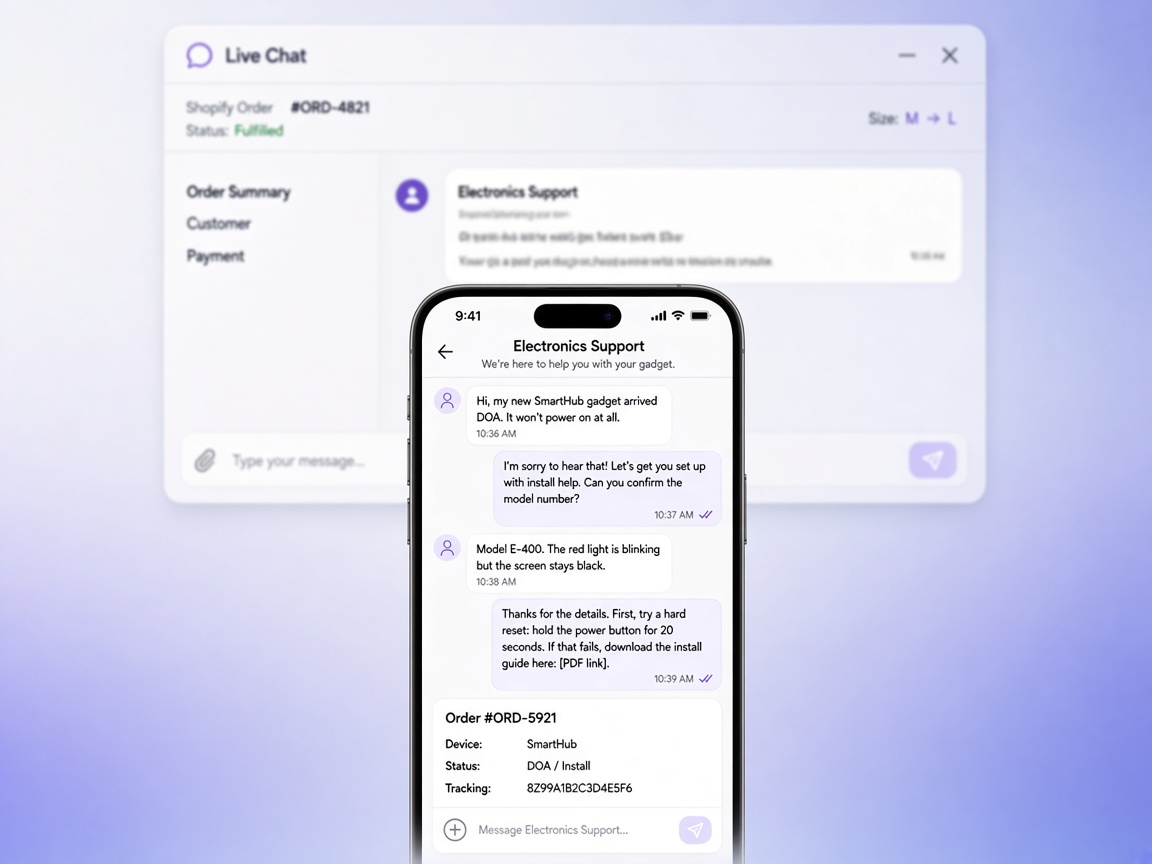
An AI chatbot for Shopify uses AI plus your store data to answer shopper questions, recommend products, look up orders, and escalate to humans when risk or uncertainty is high. It works well for repeatable support and sales assist; it fails when it invents prices, stock, or promises your ops cannot keep.
Shopify merchants do not need “more chat widgets.” They need fewer unanswered product questions, fewer WISMO tickets, and a clean path from bot to human when money or emotion is on the line. An AI chatbot for Shopify is one way to do that, if it is grounded in catalog and order truth, not a generic LLM wearing your logo.
This guide explains what these bots actually do, how they work, where they help sales vs support, when to hand off, how to choose a tool, and where TopEdge fits. For the broader messaging stack, see WhatsApp automation for Shopify. For WhatsApp-India specifics (COD tone, Meta-safe behavior), see AI WhatsApp chatbot for Shopify India.
What is an AI chatbot for Shopify?
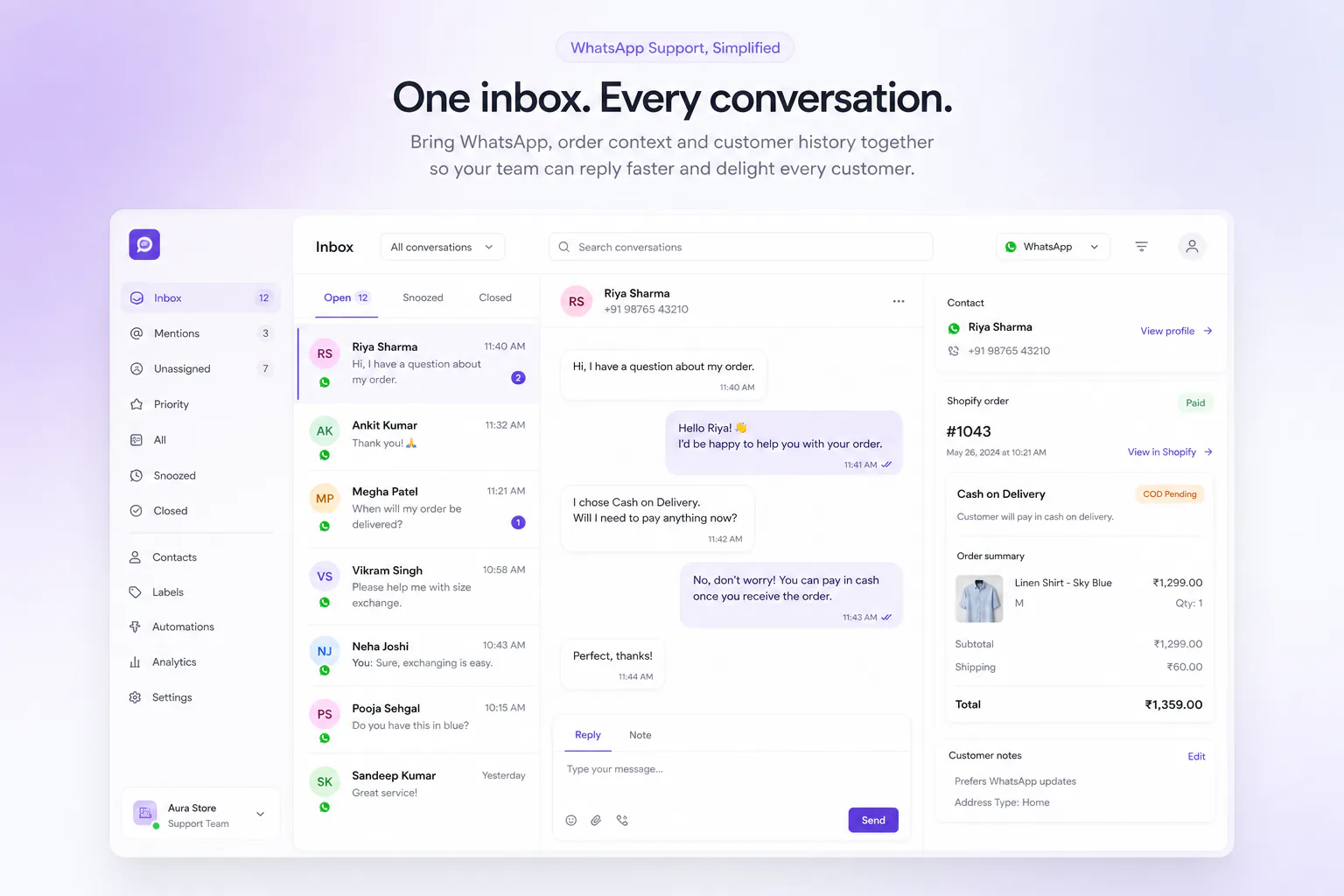
An AI chatbot for Shopify is software that converses with shoppers using artificial intelligence and, critically, store context: products, variants, policies, and often live order or cart data. It may sit on the storefront (for example via Shopify Inbox), in WhatsApp, Instagram, or inside an agent inbox as a drafting assistant.
Three related ideas get mixed up:
| Type | How it answers | Best for |
|---|---|---|
| Rule / FAQ chatbot | Button trees, keyword macros, Instant Answers | Rigid policies and predictable FAQs |
| AI chatbot / shopping assistant | Natural language + catalog/policy grounding | Open product questions, recommendations, first-line support |
| AI sales / support agent | AI plus tools (order lookup, sometimes write actions) | Resolving tickets and assisting checkout, with strict guardrails |
Shopify’s own Inbox tooling documents Instant Answers (predefined Q&A) and AI-assisted experiences that can use store policies and conversation context. That is a valid starting point. Deeper ecommerce AI usually adds multichannel delivery, stronger retrieval over catalog/orders, journey integration, and explicit human takeover.
Why AI chatbots matter for Shopify stores
Support and sales questions cluster in the same places: size and fit, shipping time, COD or payment options, “where is my order?”, returns windows, and “which product is right for me?” Humans should spend time on exceptions, not typing the same shipping paragraph at midnight.
Practical upsides when the bot is grounded:
- Faster answers while purchase intent is warm
- After-hours coverage without pretending a human is online
- Consistent policy language across agents and shifts
- Agent assist: suggested replies that staff edit, not only fully autonomous chat
Practical limits:
- Bad grounding creates wrong stock/price answers that cost more than slow replies
- Autonomous refunds or cancellations without rules create finance risk
- AI does not replace cart recovery journeys or COD confirmation workflows. Those remain event-driven systems (see abandoned cart recovery and COD confirmation)
How a Shopify AI chatbot works
- Connect store data: catalog, policies, and ideally orders/customers via Shopify.
- Ground knowledge: retrieve relevant products, shipping/return text, or order status before generating an answer.
- Classify intent: shipping vs returns vs product advice vs “talk to a human,” sometimes with cheap phrase matching before an expensive model call.
- Reply or act: answer FAQs, recommend products, return tracking links; only take write actions if you explicitly allow them.
- Hand off: escalate with full transcript and order context; pause the bot while a human owns the thread.
- Review: sample transcripts, fix wrong answers, update knowledge when policies or SKUs change.
Operator tip: Deterministic flows beat clever AI when money moves. Use Flow Builder–style menus for address updates and exchange steps; reserve open AI for catalog questions and messy language.
Support vs sales: what AI should automate
| Job | Automate? | Notes |
|---|---|---|
| Order status (WISMO) | Usually yes | Needs live order/fulfillment data, not a generic “check your email” |
| Shipping / returns policy FAQs | Yes | Cite policy text; update when ops changes windows |
| Size charts & product comparisons | Yes, with catalog grounding | Escalate medical claims or custom fit disputes |
| Product recommendations | Yes, carefully | Small set of matches + PDP links; respect stock |
| Discount hunting | Sometimes | Only offers finance approved; do not invent codes |
| Refunds / cancellations | Rules only | Thresholds, windows, and human approval for edge cases |
| Angry / legal / damage claims | No, hand off | Humans with order context |
Can AI recommend products and answer catalog questions?
Yes. This is where an AI shopping assistant earns its keep. A useful pattern:
- Clarify the shopper’s constraint (budget, size, skin type, use case).
- Retrieve matching Shopify products/variants.
- Present 2–4 options with honest differences and links.
- Offer human help if nothing fits or the shopper hesitates on high AOV.
If the model cannot see live prices or inventory, say so and hand off, or fall back to a static FAQ, rather than guessing. Hallucinated “in stock” is worse than “let me get a specialist.”
When should an AI chatbot hand off to a human?
Hand off when any of these are true:
- The customer asks for a person
- Confidence is low or retrieval found nothing solid
- Tone is angry, threatening, or distressed
- Payment failed, chargeback risk, or address disputes
- Custom quotes, wholesale, or B2B exceptions
- Medical, legal, or regulated claims
- High-value orders where a wrong answer is expensive
Handover is not a failure metric if it is fast and contextual. It is a failure when the bot loops, invents facts, or keeps talking after an agent joins. On TopEdge, Live Chat takeover is designed to pause AI and Flow Builder on that thread until release.
Hypothetical examples
Example A: Skincare storefront assist
Shopper: “Something gentle for oily skin under ₹1,500.” Bot retrieves matching SKUs, asks about fragrance sensitivity, shares two PDPs, and offers a human if they want routine building. It does not invent a festival code.
Example B: WISMO on WhatsApp
Shopper sends order number. Bot reads Shopify fulfillment state, returns carrier + tracking, and escalates if the shipment is delayed beyond policy. It does not argue about courier blame.
Example C: What not to automate day one
A brand turns on open AI with empty knowledge, allows refunds without limits, and leaves no human coverage overnight. One wrong “yes, free overnight shipping” message creates ops debt for a week. Start with FAQs + order status + hard handoff; expand intents after transcript review.
What to look for in an AI chatbot tool
- Shopify grounding: catalog, policies, orders, not only a website scrape
- Channel fit: storefront widget, WhatsApp, Instagram, or agent copilot as needed
- Handover that pauses the bot
- Intent routing: cheap routing for shipping/returns/COD before every message burns tokens
- Guardrails: no invented discounts; write-actions behind rules
- Transcript review tools: you will tune weekly
- Cost model you understand: included AI vs bring-your-own-key (BYOK) vs per-message add-ons
- Works with journeys: chatbots answer; journeys still recover carts and confirm COD
Common mistakes
- Launching ungrounded AI on a live catalog
- No handoff path (or handoff that does not pause the bot)
- Letting AI promise shipping or discounts ops cannot keep
- Replacing journeys with chat nudges only
- Measuring deflection rate while ignoring wrong-answer rate
- Training on outdated policies after a returns-window change
- Turning on write access (cancel/refund) before read-only trust exists
- One global personality for every market and COD vs prepaid shopper
How TopEdge AI approaches AI chatbots for Shopify
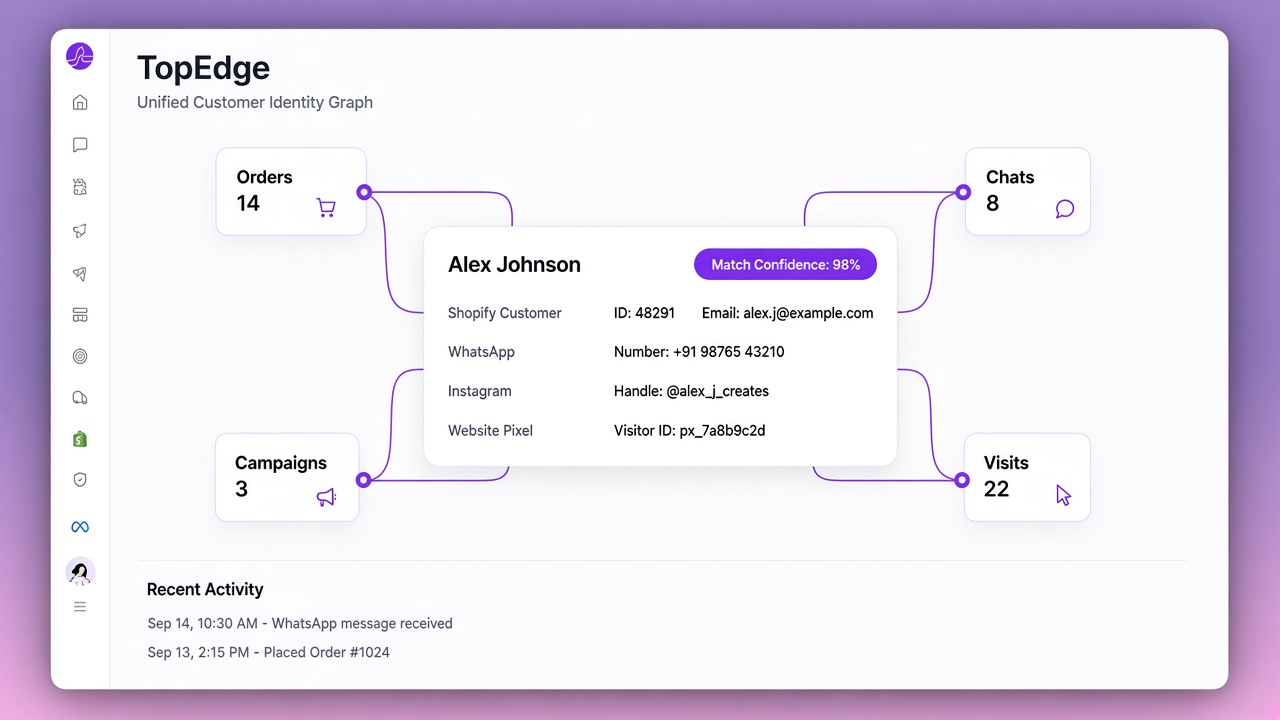
TopEdge AI is ecommerce automation software. For Shopify merchants who need AI inside WhatsApp customer conversations (not a generic website widget alone), TopEdge approaches this through grounded AI plus explicit human control.
Within TopEdge AI:
- AI Brain: bring-your-own-key models (OpenAI, Claude, or Gemini), store knowledge/RAG over policies and docs, bot persona, and activation controls so spend stays on your provider bill
- Intent Detection: route shipping, returns, COD, and handoff intents before spending model tokens on every message
- Flow Builder: deterministic WhatsApp trees with Shopify tools and AI nodes where open language helps
- Live Chat: agents see order context; takeover pauses AI and flows on that thread
- Shopify WhatsApp integration: catalog/order sync so answers can stay store-aware
AI here is a layer on customer engagement automation, not a replacement for Journeys or Meta template hygiene in Meta Manager. Plans: Pricing.
Common questions
What is an AI chatbot for Shopify?
An AI chatbot for Shopify is software that answers shopper questions using store knowledge (catalog, policies, and often live order data) then escalates to a human when confidence is low or the request is high risk. It can live on-site, in WhatsApp, or inside a shared inbox.
How does a Shopify AI chatbot work?
It connects to Shopify (and usually help content), retrieves relevant product/order/policy context, generates or selects a reply, and applies rules for when to stay automated versus hand off. Better systems ground answers in your catalog and pause AI when an agent takes over.
Can an AI chatbot answer product questions?
Yes, when it can read product titles, variants, attributes, and policies. Without grounding, it may invent fabric, ingredients, or availability. Deterministic FAQs and catalog retrieval beat freeform guessing for money-moving details.
Can AI handle Shopify customer support?
It can handle high-volume, repeatable intents like order status, shipping windows, size charts, and policy FAQs. Refunds, damage claims, angry customers, and edge-case exceptions should escalate to humans with full conversation context.
Can an AI chatbot access Shopify product information?
A useful ecommerce AI chatbot should. Access may mean synced catalog embeddings, live Admin API lookups, or both. If the bot cannot see SKUs, prices, and stock truth, treat it as a marketing widget, not support infrastructure.
Can AI recommend products?
Yes, as a shopping assistant: clarify need, filter catalog attributes, and present a small set of matches with links. Recommendations should respect inventory and avoid promising discounts ops cannot honor.
When should an AI chatbot hand a customer to a human?
Hand over on low confidence, complaints, payment failures, custom pricing, medical/legal claims, high-AOV disputes, and anytime the customer asks for a person. Takeover should pause the bot so humans and AI never talk over each other.
Can AI help increase ecommerce conversions?
It can remove friction (answering size, shipping, COD, and product-fit questions while intent is warm) and assist agents with suggested replies. Conversion lift depends on answer quality, speed, and channel fit; it is not guaranteed by installing a model.
Is Shopify Inbox enough, or do I need a third-party AI chatbot?
Shopify Inbox offers free storefront chat, Instant Answers, and AI-assisted reply features for many merchants starting out. Third-party tools matter when you need WhatsApp-native AI, deeper journey/inbox automation, BYOK models, or stricter grounding and handover controls across channels.
Shopify Inbox Instant Answers behavior referenced from Shopify Help Center. Competitive market context informed by public Shopify and third-party explainers; no conversion percentages invented. TopEdge AI Brain / Intent Detection / Live Chat capabilities from TopEdge product pages. Re-check Shopify Inbox and Meta policies before production launches.
An AI chatbot for Shopify is useful when it is store-aware, limited where money moves, and quick to hand off. Start with grounded FAQs and order status, review transcripts weekly, then expand sales assist.
Next steps: AI Brain, Live Chat, pricing, or start free. Cluster links: WhatsApp automation for Shopify, AI WhatsApp chatbot (India), shared inbox.