Top 5 Product Categories to Sell Online in 2026
The five highest-demand ecommerce categories for 2026 with realistic margins: smart home, eco-friendly, health and wellness, pet care and athleisure.

Direct answer
The five product categories with the strongest demand and realistic room for a new seller in 2026 are smart home and tech accessories (40–65% gross margin), eco-friendly products (55–70%), health and wellness (55–75%), pet care (45–65%) and athleisure (45–65%). The category you pick determines your margin, return rate, shipping cost and repeat purchase rate — which is why it matters more than almost any later decision.
Most people starting an online store think about how to set up the store, run ads and handle shipping. All of that matters, and none of it matters if the product category is wrong.
Your category determines almost everything: gross margin, return rate, competition level, shipping cost, and how often customers come back. Two sellers with identical stores, budgets and work ethic will have completely different results after six months if one picked a high-margin category with strong repeat demand and the other picked a saturated low-margin one.
In 2026 the market is more competitive than it was three years ago. Categories that were wide open in 2021 are crowded now. That does not mean opportunity is gone — it means the remaining opportunities are more specific. The sellers doing well found a niche within a growing category, understood their buyer, and built something that felt different from the first page of results.
The five categories, and what each really pays
| Category | Gross margin | Repeat purchase | Main risk |
|---|---|---|---|
| Smart home and tech accessories | 40 – 65% | Low | Short product life cycle; competitors flood in within 12–18 months. |
| Eco-friendly products | 55 – 70% | Medium | Needs genuine brand story; buyers detect greenwashing. |
| Health and wellness | 55 – 75% | Very high | FSSAI compliance for supplements takes time and money. |
| Pet care | 45 – 65% | High | Buyers research heavily; thin product pages do not convert. |
| Athleisure | 45 – 65% | High | Fashion-level return rates; margin depends on brand, not price. |
1. Smart home devices and tech accessories
This category has grown consistently for four years with no sign of slowing. What makes it attractive is the range of price points — you do not need to sell expensive smart speakers to compete. The best performers are small practical accessories solving everyday problems: LED light strips, mini security cameras, smart plugs, phone and tablet stands, cable management, fast-charging power banks, wireless charging pads.
These share important traits. Small and light, so shipping stays cheap. High perceived value relative to manufacturing cost. Broad demographic appeal rather than tech-only buyers.
Branded, well-packaged versions of common accessories consistently outperform generic listings on both search and conversion. The thing to watch is product life cycle: tech items can trend for 12 to 18 months and then plateau as competitors flood in. Picking products with functional utility rather than novelty gives you a longer window. In India, growth is strongest in metro and Tier 1 cities, where premium-feeling products at accessible prices win.
2. Eco-friendly products
Sustainability has moved into mainstream buying decisions, particularly for buyers between 20 and 40 looking for alternatives to single-use plastic. The items generating consistent sales are reusable bottles and tumblers, bamboo toothbrushes, combs and kitchen utensils, organic cotton totes and produce bags, beeswax wraps and compostable storage, natural cleaning products, and plant-based personal care.
What sets this category apart is willingness to pay a premium. A buyer who specifically wants an eco-friendly product is not comparing your bamboo toothbrush to the cheapest plastic one — they already decided they want the sustainable option. The question is which brand. That changes the competitive dynamic in your favour if you present the product well.
Margins are strong at 55 to 70 percent because the brand story commands a price the production cost would not suggest. For dropshipping specifically, this is one of the better options available, because the growing number of domestic Indian suppliers producing natural products solves the delivery-timeline problem that breaks international dropshipping. Packaging matters more here than elsewhere: clean, minimal, sustainable-looking packaging reinforces the message and lifts perceived value.
3. Health, wellness and personal care
Health and wellness became a mainstream spending category during the pandemic and demand has not returned to pre-2020 levels. The category spans supplements (protein, vitamins, collagen, immunity, sleep), skincare with transparent ingredient lists, plus fitness accessories, massage tools, posture correctors, air purifiers, and mental wellness products like diffusers and guided journals.
Repeat purchase here is among the highest of any ecommerce niche. Supplements run out. Skincare gets used up. A customer who likes your product returns every 30 to 60 days without you spending on acquisition again — which makes the unit economics substantially better than one-time purchase categories over time.
In India there is a genuine white space in the crossover between traditional wellness, Ayurvedic ingredients and modern product formats. Brands combining trusted Indian ingredients with clean modern branding are finding an audience both domestically and across the diaspora.
Margins are good — supplements 60 to 75 percent, skincare 55 to 65 percent — but the regulatory environment needs attention. FSSAI compliance is mandatory for supplements sold in India. Factor the time and cost in before you launch.
4. Pet care supplies
Pet ownership has risen sharply across India, and more importantly the way people think about pets has shifted: they are treated as family, which means spending on food, health, accessories and comfort has risen consistently.
The category is still relatively underpenetrated in India compared with Western markets, so there is real room to establish yourself before it gets as competitive as the US or UK. What performs well: premium food and treats, especially natural and grain-free; grooming kits; orthopedic and memory foam beds; interactive toys and feeders; travel carriers; and pet health supplements. The premium end is growing faster than the budget end, because owners who buy online tend to be willing to spend on quality.
The business case is the combination of high loyalty and high repeat frequency. Food is a consumable. Treats run out. Owners who find a brand their pet responds to are reluctant to switch even when something cheaper exists. That builds a predictable revenue base.
One practical note: pet owners research heavily before buying. Product pages with real detail on ingredients, materials, safety testing and sizing convert significantly better than basic listings.
5. Athleisure and activewear
Athleisure — where gym wear meets everyday casual — is one of the most durable trends in apparel. It did not start in 2020, but working from home accelerated it, and many people never went back to structured workwear.
Yoga pants, joggers, sports bras, gym shorts, hoodies and training shoes all see consistent search and sales volume. What makes it interesting for D2C is how well it performs on Instagram and how repeat-driven it is. Buyers in this category follow specific aesthetics. If someone likes how your brand looks and feels, they come back for new pieces, follow for drops, and share outfit content voluntarily. Organic word-of-mouth potential is higher than most fashion subcategories.
Private label is well established in India, with capable manufacturers in Surat, Tirupur and Ludhiana. A private label athleisure brand with good fabric, clean branding and a defined aesthetic can enter with roughly ₹50,000 to ₹80,000 starting capital and find traction within a few months if product and marketing are right.
Margins depend heavily on fabric quality and positioning — premium private label can reach 55 to 65 percent, mid-market competitive pricing sits at 45 to 55 percent. The key to protecting margin is brand loyalty, so you are not competing on price. Be realistic about returns: this is apparel, and fashion RTO in India runs high. Read the COD and RTO benchmarks before you model your numbers.
How to find trending products for your store
Knowing which categories are growing is the starting point. Finding the specific product that is still early, has real demand and is not oversaturated is the actual skill.
- Google Trends. Check 12-month and 5-year lines. Steady upward growth beats a single spike — spikes usually mean a viral moment that is already over.
- Amazon and Flipkart subcategory bestsellers. Drill three or four levels down. Positions 20 to 100 are often where the opportunity is: enough demand to be real, not yet dominated by funded brands.
- Instagram and YouTube. Products appearing repeatedly in Reels, unboxings and creator reviews are usually three to six months ahead of where Google Trends will eventually show the same signal.
- IndiaMART and Alibaba. When domestic manufacturers start promoting a category heavily, multiple buyers are already ordering it.
The most important filter: can you serve the existing demand better than what is available? Not necessarily cheaper. Better branding, better information, better customer experience, or better quality at a similar price. If yes, you have a starting point.
Choosing a product you can actually profit from
Balancing margin against shipping cost
A commonly overlooked mistake is picking something with strong gross margin but shipping costs that eat it. A product costing ₹200 to make and selling at ₹700 looks great until ₹150 of shipping on a bulky package drops margin from 71 percent to around 50 — before platform fees, ads and returns.
The best margin-to-shipping ratios come from products that are small, light and high in perceived value: tech accessories, skincare, supplements in compact packaging, jewellery, certain pet accessories.
Before committing, calculate the volumetric weight of your likely packaging — length × width × height ÷ 5,000. Couriers charge on whichever is higher, actual or volumetric. A 200g product in a bulky box can cost more than expected. Aim for shipping at no more than 10 to 15 percent of selling price. If it is higher, raise the price or make the packaging more compact.
Reading demand against saturation
You need two separate pieces of information: whether enough people want the product, and whether the competitive environment is open enough to get traction.
For demand, check monthly search volume for your main keywords with Google Keyword Planner, Ubersuggest or Semrush. 5,000 to 50,000 monthly searches in India is a reasonable signal. Below 1,000 means a very small audience. Above 100,000 usually means a mainstream category where competition is intense.
For competition, look at the first page of Amazon or Google for your main keyword. How many reviews do top listings have? Are they established national brands with large budgets? Are there gaps — weak photos, thin descriptions, no reviews?
A category where the top ten listings have thousands of reviews from funded brands is difficult without significant capital. A category where top results have 50 to 200 reviews and look average is a much more open field. The sweet spot is steady demand plus a landscape with visible gaps. That combination gives you a path to your first 100 to 500 orders before larger players notice.
What happens after you pick the category
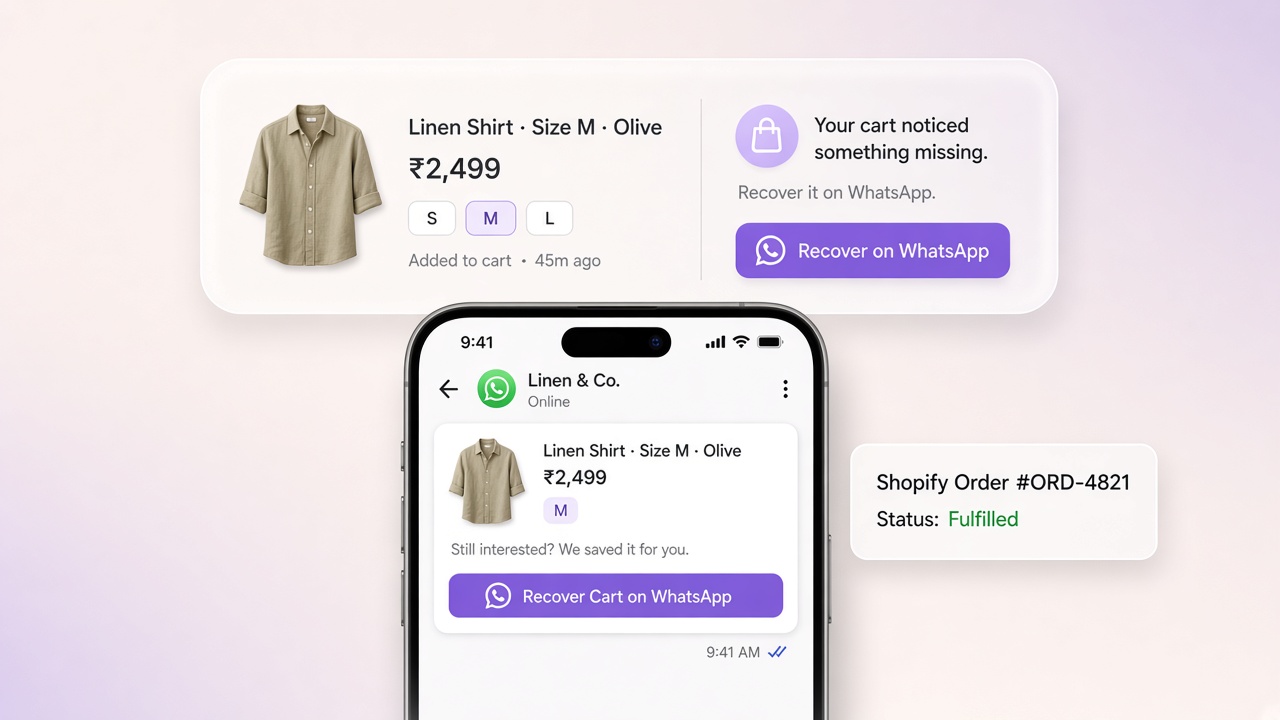
Picking the category and launching the store is the beginning. Once orders arrive, a different set of problems shows up: COD confirmations, order updates, abandoned carts, questions coming in across channels. For most sellers this is where it starts to feel like too much.
TopEdge automates that layer for Indian D2C brands. It connects to Shopify and runs cart recovery and order lifecycle journeys on WhatsApp, sends COD confirmation and prepaid conversion messages before dispatch to reduce RTO exposure, and keeps order updates flowing automatically. Audience CRM adds lead scoring and segmentation, and profit and costs shows real net margin per product after cost of goods, shipping, RTO and fees — which is exactly the number this guide has been pointing at.
If you are still deciding whether your unit economics work at all, start with how to run a profitable ecommerce business in India, then automate the operations once orders are consistent.
Pick a category with momentum, then do the work
These five categories are not trending because of hype. They are growing because of real shifts in how people spend, what they care about, and how they discover products.
Picking one is not a guarantee. You still need the right product within it, a clear view of your buyer, pricing that leaves real margin, and a customer experience worth returning to. But starting in a category with genuine momentum is a far better foundation than entering one that is overcrowded or declining.
Research first, validate before scaling, and build systems that let you operate without burning out.
Next: set up your store automation in about 30 minutes, compare plans on pricing, or start free on your Shopify store.
Common questions
What are the best product categories to sell online in 2026?
The five with the strongest combination of demand growth, margin potential and room for a smaller seller to compete are smart home and tech accessories, eco-friendly products, health and wellness, pet care, and athleisure. Each has a clear entry point at modest capital and room to scale once you find traction.
Which ecommerce category has the highest profit margin?
Health supplements typically carry the highest gross margin at 60 to 75 percent, followed by eco-friendly products at 55 to 70 percent where the brand story supports a premium. Remember that gross margin is not profit — shipping, acquisition cost, payment fees and returns all come out before you see net margin.
How do I find trending products for my online store?
Use Google Trends for 12-month and 5-year lines, preferring steady growth over single spikes. Drill three or four levels into Amazon and Flipkart subcategory bestseller lists, where positions 20 to 100 often hold the real opportunity. Watch Instagram and YouTube for products gaining attention three to six months before search data shows it. Check IndiaMART and Alibaba to see what is being produced in volume.
What shipping cost should I aim for as a percentage of price?
No more than 10 to 15 percent of your selling price. If it is higher, either the price needs to rise or the packaging needs to become more compact. Always calculate volumetric weight — length × width × height ÷ 5,000 — because couriers charge on whichever is higher between that and actual weight.
How much search volume indicates real demand?
In India, 5,000 to 50,000 monthly searches for your main keywords is a reasonable signal of genuine demand. Below 1,000 means the audience is very small. Above 100,000 usually means a mainstream category where competition is already intense and capital decides outcomes.
How do I know if a category is too saturated to enter?
Look at the first page of Amazon or Google for your main keyword. If the top ten listings have thousands of reviews from well-funded national brands, it will be hard without significant capital. If the top results have 50 to 200 reviews with average photos and thin descriptions, that is an open field for a better product and better presentation.