COD to Prepaid on WhatsApp for Shopify India 2026
Convert Shopify India COD orders to UPI prepaid on WhatsApp before dispatch: the ₹68 saved per order, the ₹0.1150 against ₹0.8631 template split, and the flow.
Quick verdict
A Cash on Delivery order that becomes a prepaid order saves roughly ₹68 before it ships: about ₹30 of courier COD remittance fee and about ₹38 of amortised RTO cost. That is the budget for your incentive. Send the ₹0.1150 utility confirmation to every COD order first, then the ₹0.8631 marketing offer with a UPI link only to the segment worth converting, and hold dispatch until one of the two comes back.
Every Indian D2C brand knows prepaid orders behave better. Almost none can say what one is worth in rupees, which is why the prepaid discount is usually picked by feel and then quietly abandoned when nobody can prove it paid.
This is the arithmetic, the message sequence that does not cost 7.5 times more than it needs to, and the part we cannot source.
The payment method is the largest RTO lever you control
Not category, not city, not courier. Payment method.
| Measure | COD | Prepaid | Source |
|---|---|---|---|
| Festive-quarter return rate, FY26 | 58% | under 15% | Unicommerce India D2C Report 2026 |
| RTO across the GoKwik shopper network | near 26% | under 2% | GoKwik, via First Resort |
| Share of RTOs caused by low buying intent | 60% to 70%, not logistics failure | GoKwik, via First Resort | |
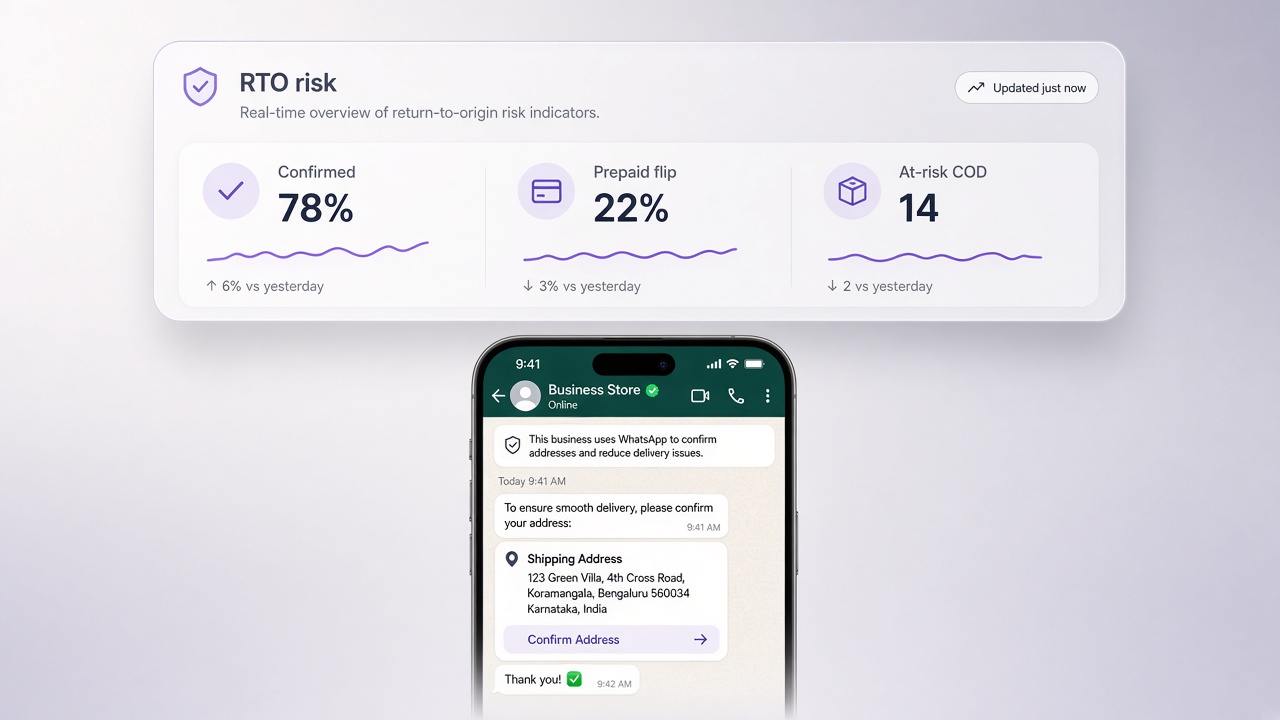
Read the last row with the first. If two thirds of your returns come from low intent rather than a courier problem, then the fix is a filter before dispatch, and a payment is the strongest filter there is. A buyer who has paid has already cleared it. Full benchmark set in the 2026 India COD and RTO report.
What a prepaid order is actually worth: about ₹68
Two cost lines disappear the moment an order is paid for, and Amazon Shipping India publishes both in its worked unit-economics breakdown.
| Cost line on a COD order | Typical figure | Still there if prepaid? |
|---|---|---|
| Courier COD remittance fee | ₹30 a parcel, or 1.5% of order value, whichever is higher | No |
| Amortised RTO cost, at a 30% COD RTO rate | ₹38 per shipped order (30% of ₹125 incremental reverse cost) | Largely no |
| Payment gateway fee | Charged on the paid order instead | New cost, typically under ₹20 on a ₹1,000 order |
| Net saved per converted order | About ₹68 before gateway fees |
So the discount question answers itself. An incentive of ₹30 to ₹50 sits inside what the conversion already saves. Above about ₹68 you are paying for the privilege, unless you are also counting the parcels that no longer come back, each of which costs ₹180 to ₹240 in direct logistics and ₹450 to ₹900 fully loaded.
That second half is real money and it is also the part people over-claim, so keep the two separate on your own P&L. The ₹68 is arithmetic. The avoided RTO depends on a conversion rate you have not measured yet.
Why the offer must be a second message
This is the single most expensive formatting mistake in Indian D2C WhatsApp, and it is invisible until the invoice arrives.
A confirm-or-cancel message is a utility template: ₹0.1150 per delivered message on Meta's India card. Add "pay by UPI now and get ₹50 off" to the same message and Meta reclassifies it as marketing: ₹0.8631. One line of copy, 7.5 times the cost, charged on every COD order you ship rather than on the ones worth converting.
| Approach on 500 COD orders a month | What gets sent | Meta cost |
|---|---|---|
| One step: confirmation with the offer inside it | 500 marketing templates at ₹0.8631 | ₹431.55 |
| Two steps: utility confirm to all, offer to the 40% worth converting | 500 utility at ₹0.1150, then 200 marketing at ₹0.8631 | ₹230.12 |
The two-step version is cheaper and it is also better operationally, because the confirmation reply tells you which orders deserve the offer. Against the ₹180 to ₹240 you lose on a single returned parcel, both numbers are rounding errors, which is the real point: the message is never the expensive part of this problem. The category rules are in the India WhatsApp API pricing guide, and the reasons templates get rejected in the template rejection fixes.
The flow, step by step
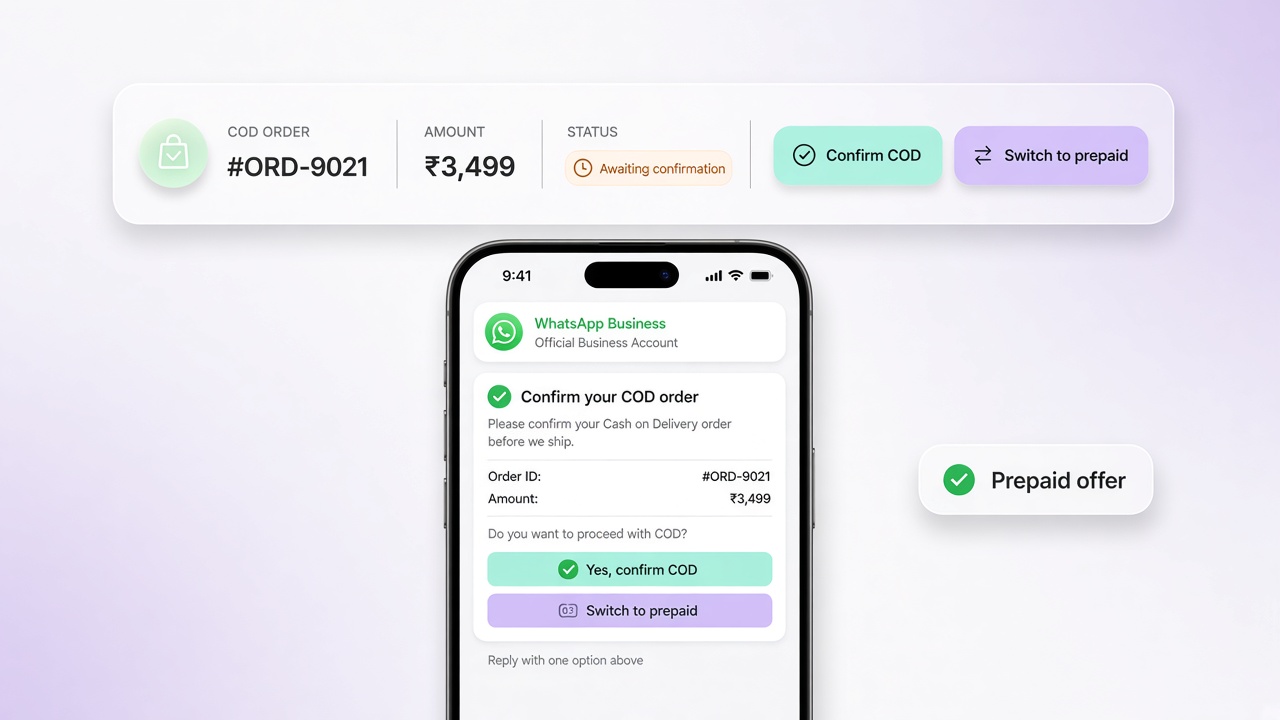
- Minute 0, order placed. Utility template with the order number and ₹ total, and a Confirm or Cancel button. ₹0.1150. This is the flow in the COD confirmation SOP, unchanged.
- Branch on the reply. Cancel stops fulfillment. Confirm releases to pick and pack, unless the order qualifies for step 3.
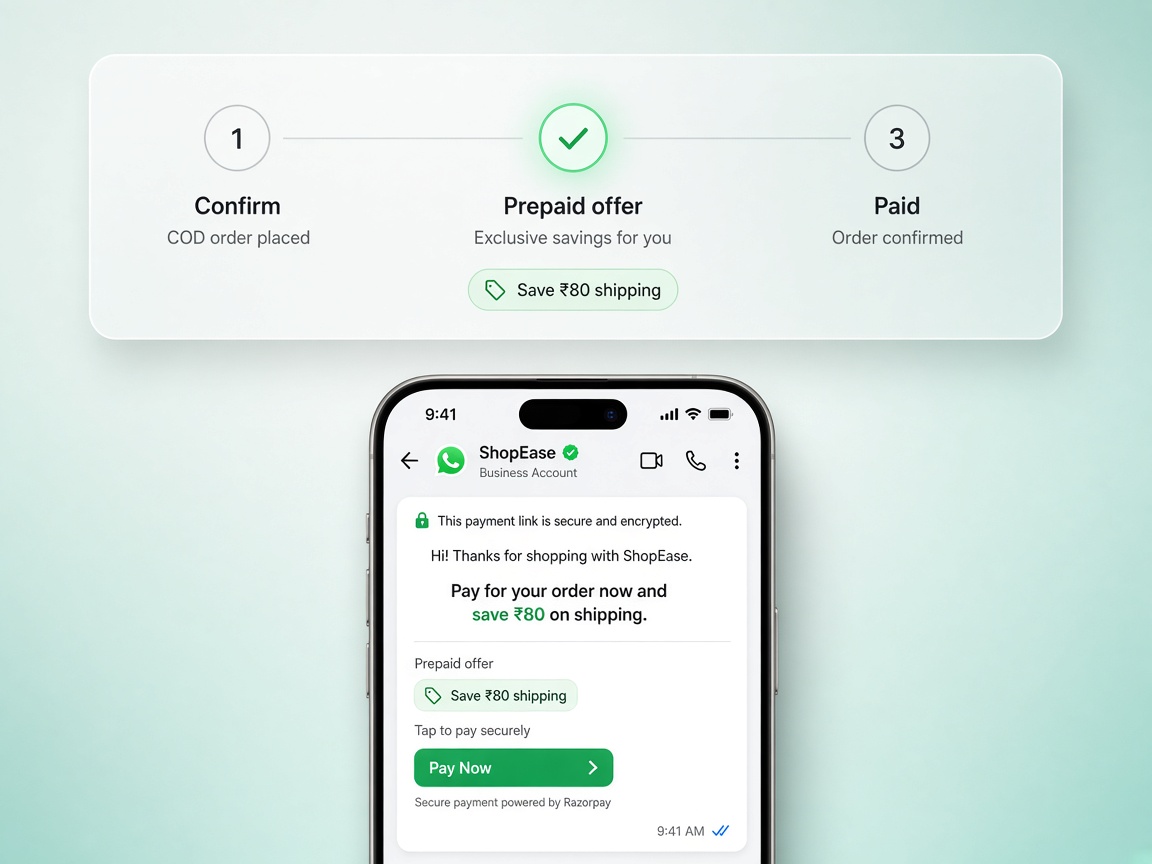
- Qualify, then offer. Send the prepaid offer only where the margin supports it: high-RTO pincodes, your higher order values, repeat refusers. A marketing template with a pre-filled payment link, ₹0.8631.
- Hold dispatch until one of the two lands. Payment cleared, or an explicit COD confirmation. An unverified COD order sitting in a packed carton is the thing the whole program exists to prevent.
- Sync back to Shopify. The order moves to paid, the COD tag comes off, and the warehouse sees one truth rather than two.
- Cancel the offer on payment. Suppression matters here as much as in cart recovery. A buyer who has paid should never receive the follow-up, and you should not pay ₹0.8631 to annoy them.
One rule worth writing into the SOP: never promise a discount you cannot apply to an order that is already placed. If your stack cannot re-price a Shopify order cleanly, make the incentive a credit on the next order instead. A broken promise at the payment step costs more than the RTO would have.
Price it against your own COD volume
The saving per converted order is fixed arithmetic. What it is worth to you depends on how many COD orders you ship and how many come back, so put your own numbers in.
What RTO costs your store a month
Put in your order volume and COD mix to see the rupee loss behind your RTO rate, and what one WhatsApp confirmation pass over the same orders costs.
| COD orders a month60% of 1,000 orders | 600 |
|---|---|
| Parcels that come back26% of those COD orders | 156 |
| Direct logistics loss₹180 to ₹240 a parcel: forward freight, reverse leg, repackaging, holding | ₹28,080 to ₹37,440 |
| Fully loaded loss₹450 to ₹900 a parcel once written-off acquisition spend is counted | ₹70,200 to ₹1,40,400 |
| Confirming every COD order on WhatsApp600 utility templates at ₹0.1150, at 0% markup | ₹69.00 |
One confirmation message on every COD order costs ₹69.00 a month. The parcels that come back cost ₹28,080 to ₹37,440 in direct logistics over the same month, or ₹70,200 to ₹1,40,400 fully loaded, so the confirmation pass pays for itself if it prevents 1 of them.
Cost bands from Amazon Shipping India’s RTO breakdown (₹180 to ₹240 direct) and ClickPost figures compiled by First Resort (₹450 to ₹900 fully loaded), national RTO rates from Unicommerce’s India D2C Report 2026, all read 21 October 2026. Message rate from Meta’s published India card. This models your inputs against published bands, it is not a forecast: your own courier mix and pincode spread move it.
What we could not verify
Plenty of vendors publish a COD-to-prepaid conversion rate. We could not find one in a dataset that names its sample, so we are not repeating any of them, and you should treat the ones you see in a sales deck the same way.
What is published and attributable is the return-rate gap between COD and prepaid, and the per-order cost lines above. That is enough to decide: the saving per converted order is known, so you only need your own conversion rate to finish the sum, and you will have that within a month of running it.
Measure three things and nothing else at the start: share of COD orders that take the prepaid offer, RTO rate on converted orders against unconverted ones, and net margin after the incentive. The third one is the only one that settles it, and it is the one most dashboards cannot show you. Profit and costs builds that waterfall from your own Shopify data, and the India net profit guide walks through the rest of the cost lines.
Where this runs
COD confirmation is on every TopEdge plan, from Launch at ₹1,999 a month. The automated COD-to-prepaid journey, with the payment link and the suppression rules above, sits on Growth at ₹3,999 a month (₹3,199 billed yearly) and on Scale. TopEdge is Shopify-native and compatible with third-party checkout stacks such as GoKwik and Razorpay.
On the Meta side there is nothing to add: you connect your own WhatsApp Business Account, Meta bills that account directly at its published rates, and we take 0% of it. Plans and limits are on pricing, the flow itself on COD confirmation, and the branching on Journeys.
While you are costing this, check one thing that has a deadline attached. Every eligible Indian WhatsApp Business Account has to be on INR billing by 31 December 2026 or Meta stops delivery on 1 January 2027, and that migration needs a new WABA rather than a settings change.
Frequently asked questions
How do you convert COD orders to prepaid on WhatsApp in Shopify India?
Send a plain utility confirmation the moment the Cash on Delivery order is placed, at ₹0.1150 on Meta’s India rate card. Branch on the reply, then send a separate marketing template with a UPI payment link and a small incentive only to the orders worth converting, at ₹0.8631. Hold dispatch until the payment clears or the buyer confirms COD, and sync the paid status back to the Shopify order.
How big a prepaid discount can I offer without losing money?
Work from what a prepaid order saves you rather than from a round number. Amazon Shipping India puts the COD remittance fee at about ₹30 a parcel (or 1.5% of order value) and amortised RTO cost at about ₹38 per shipped COD order at a 30% RTO rate. That is roughly ₹68 of cost that disappears when the same order goes prepaid, so an incentive below ₹68 is already paid for before you count the parcels that no longer come back at ₹180 to ₹240 each.
Why not just put the prepaid discount inside the COD confirmation?
Because it changes the Meta template category. A confirm-or-cancel message is a utility template at ₹0.1150. Add a discount to the same message and Meta reclassifies it as marketing at ₹0.8631, which is 7.5 times the cost on every COD order you ship, including the ones that were never going to convert. Two sends cost less than one when only part of your COD base is worth an offer.
Does converting COD to prepaid actually reduce RTO?
The payment method gap is the largest published one in Indian D2C. Unicommerce reports festive-quarter COD returns around 58% against under 15% for prepaid, and GoKwik reports COD RTO near 26% against prepaid under 2% across its shopper network, with 60% to 70% of RTOs coming from low buying intent rather than logistics failure. What no one publishes is a verified conversion rate for WhatsApp prepaid offers, so model the saving per converted order and measure your own rate.
Which TopEdge plan includes COD to prepaid?
COD confirmation runs on every plan, including Launch at ₹1,999 a month. The automated COD-to-prepaid journey sits on Growth (₹3,999 a month, or ₹3,199 billed yearly) and Scale. TopEdge is Shopify-native and compatible with third-party checkout stacks such as GoKwik and Razorpay, and Meta bills your own WhatsApp account directly at 0% markup either way.
Related: the 2026 India COD and RTO benchmark, the WhatsApp COD confirmation SOP, India WhatsApp API pricing and net profit after COD and RTO.
Sources, all read 21 October 2026. COD remittance fee (₹30 or 1.5%), amortised RTO cost (₹38 per shipped order at 30% RTO) and the itemised ₹180 to ₹240 loss per returned parcel: Amazon Shipping India's true cost per order breakdown and its RTO guide. Festive COD and prepaid return rates: Unicommerce's India D2C Report 2026. GoKwik's COD and prepaid RTO figures and the intent split: ClickPost and GoKwik data compiled by First Resort. Per-message rates, template categories and the 31 December 2026 INR billing deadline: Meta's WhatsApp Business Platform pricing documentation. Gateway fees vary by provider and order value. Cost bands are national indicative ranges, not your rate card.